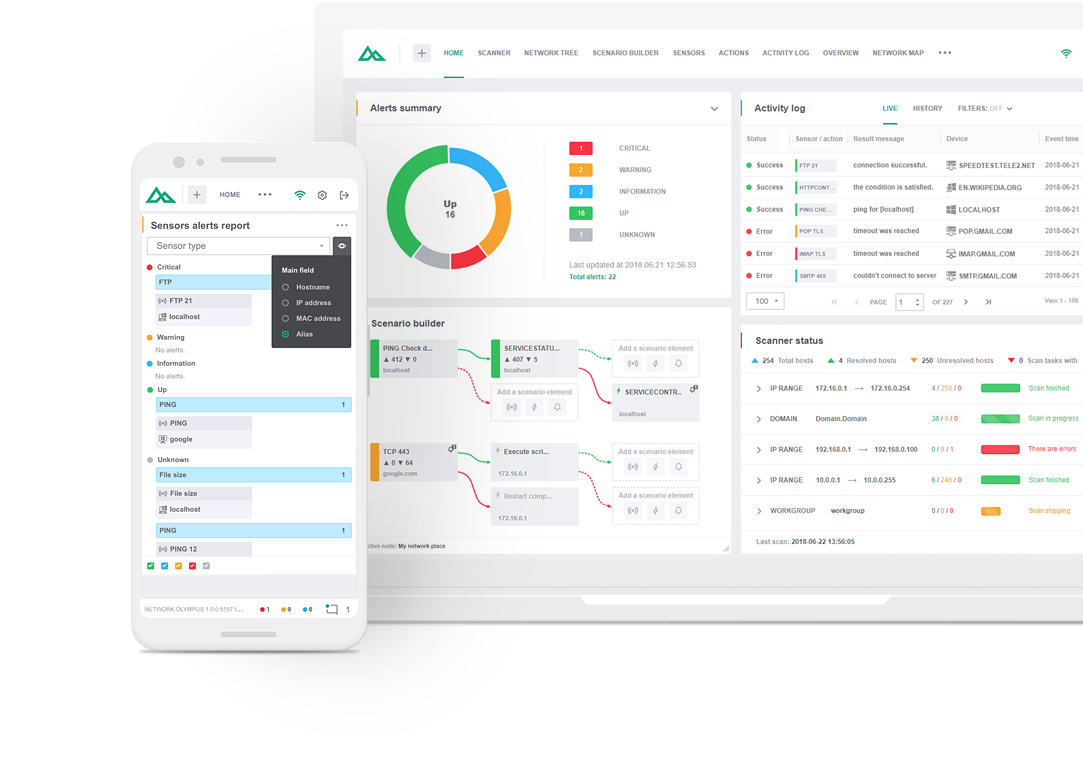
Network Olympus: Monitoring
Allows you to perform continuous real-time monitoring of servers.
Version: 1.8.3 - April 16, 2025 - All Windows
: Uniform Integrability (Ch 13) and Central Limit Theorem (Ch 18).
For problems not fully covered in the sources above, reviewers from Math Stack Exchange suggest pairing the text with: Probability with Martingales
Turn to the back of the book and try to reverse-engineer Williams’ brief hint.
Several doctoral students and professors have compiled LaTeX-typeset solution manuals on GitHub.
The book's exercises are integral to the learning process, not an afterthought. They are:
If you are working through a specific chapter right now, let me know: Which you are currently studying The exercise number you are stuck on What progress or proof strategy you have attempted so far
While the introductory chapters on measure spaces are standard, certain sections of the book almost universally require students to consult external solutions: Chapter 4: Independence
: Offers detailed, conversational walkthroughs for many of the "Exercises G" and "EG" problems, such as the famous planet communication and line segment problems.
When referencing an online solution, do not just read it. Write it out line-by-line to ensure you understand every logical transition.
So search wisely, solve honestly, and soon you will find that the best solution manual is the one you write yourself—with a little help from the best guides along the way.
To get the most out of the book and its solutions, focus heavily on these foundational sections: Chapter 4: Conditional Expectation
Mastering the intuitive vs. technical understanding of
: This is widely considered the most comprehensive resource. It provides organized, chapter-by-chapter answers for everything from measure spaces to independence.
: Uniform Integrability (Ch 13) and Central Limit Theorem (Ch 18).
For problems not fully covered in the sources above, reviewers from Math Stack Exchange suggest pairing the text with: Probability with Martingales
Turn to the back of the book and try to reverse-engineer Williams’ brief hint.
Several doctoral students and professors have compiled LaTeX-typeset solution manuals on GitHub.
The book's exercises are integral to the learning process, not an afterthought. They are:
If you are working through a specific chapter right now, let me know: Which you are currently studying The exercise number you are stuck on What progress or proof strategy you have attempted so far
While the introductory chapters on measure spaces are standard, certain sections of the book almost universally require students to consult external solutions: Chapter 4: Independence
: Offers detailed, conversational walkthroughs for many of the "Exercises G" and "EG" problems, such as the famous planet communication and line segment problems.
When referencing an online solution, do not just read it. Write it out line-by-line to ensure you understand every logical transition.
So search wisely, solve honestly, and soon you will find that the best solution manual is the one you write yourself—with a little help from the best guides along the way.
To get the most out of the book and its solutions, focus heavily on these foundational sections: Chapter 4: Conditional Expectation
Mastering the intuitive vs. technical understanding of
: This is widely considered the most comprehensive resource. It provides organized, chapter-by-chapter answers for everything from measure spaces to independence.