English Milf Pics Best __link__ Jun 2026

For the most accurate results from NormalizeScaleGradient, you need to purchase a license for the C++ module NSGXnml. This runs in the background and enables all of NSG's extra capabilities. See the Purchase page.


Customer Reviews (NSG)

English Milf Pics Best __link__ Jun 2026

Making history with her Academy Award win for Everything Everywhere All at Once at age 60, Yeoh proved that an older woman could anchor a high-concept, physically demanding sci-fi action film that was both a critical darling and a massive commercial success.

Mature women are increasingly cast as brilliant, cutthroat, and highly capable leaders. In the hit series Hacks , Jean Smart portrays a legendary Las Vegas comedian fighting to maintain her legacy in a changing cultural landscape. Her character is narcissistic, driven, deeply flawed, and fiercely funny. Similarly, Michelle Yeoh’s Oscar-winning performance in Everything Everywhere All at Once placed a middle-aged, exhausted laundromat owner at the center of an epic, multi-dimensional action film, proving that physical prowess and emotional heroism are not the exclusive domain of the young. 3. Complicated Family and Social Dynamics

Davis has utilized her production company to champion stories of women of color, ensuring that the intersection of age and race is treated with dignity, power, and historical accuracy, as seen in The Woman King .

However, the momentum is irreversible. Mature women in entertainment have proven that age brings a depth of experience, emotional intelligence, and artistic discipline that cannot be manufactured by youth alone. As cinema continues to evolve, the industry is discovering a truth that audiences have known all along: the stories of women who have truly lived are often the most fascinating stories left to tell. english milf pics best

That last one is called The Cutting Room . Margo wrote it in six weeks of sleepless fury after she was fired from a prestige TV show for being “too harsh in the lighting tests” (translation: her face showed her age). She’d offered it to seven production companies. Seven passes. One producer wrote back: “Beautiful writing. But who’s the young lead?”

The presence of mature women in entertainment and cinema serves as an inspiration to a new generation of women. It shows that women can continue to grow, learn, and evolve throughout their lives, and that age is not a limitation.

By the 1980s and 1990s, ageism in Hollywood had become a significant issue. Women over 40 were often told they were "over the hill" or that their marketability had decreased. Roles for mature women were scarce, and those that existed were often stereotypical or demeaning. Making history with her Academy Award win for

To help tailor this or future content for your specific needs, let me know:

The industry operated under the assumption that audiences only valued women as objects of youth and desire. When an actress aged out of those categories, the roles dried up. This phenomenon created a visual deficit in culture, leaving a massive demographic—mature women—completely unrepresented in the media they consumed. The Architects of the Shift

By taking control of the financial and developmental levers of Hollywood, these women have ensured that narratives surrounding aging are authentic, diverse, and abundant. Shifting Narratives: From Caricature to Complexity Her character is narcissistic, driven, deeply flawed, and

The proliferation of streaming services and premium cable networks over the last decade has been the single greatest catalyst for the visibility of mature women. Unlike traditional network television or mainstream Hollywood studios, which often rely on broad, youth-centric demographics to secure advertisers or massive opening weekends, streaming platforms thrive on niche markets and subscriber retention.

Historically, the cinematic landscape treated aging as a liability for women while celebrating it as "distinguished" for men. Early Hollywood legends frequently saw their leading roles dry up in mid-life.

Here is a helpful guide to
Xu Kang, May 2025

... Your dedication to advancing astrophotography post-processing deserves sincere appreciation. I look forward to pushing the boundaries of imaging with these sophisticated algorithms.

Sky at Night magazine, October 2023, p78

Mathew Ludgate, Astronomy Photographer of the year shortlisted entrant in the 'Stars and Nebulae' category:

... After using the WBPP script in PixInsight to perform image calibration and registration, I utilised the Normalize Scale Gradient (NSG) script by John Murphy. This corrects the brightness and gradient of your subs using differential photometry to model the relative scales and gradients. I image at a dark site but I still find NSG very useful as a first step...

Paul Denny, 2023

... thank you for writing this script [NSG] and making it available to the astrophotography community. I am quite new to this and still on a steep learning curve, but I do know enough to see what a great tool this is, as is your excellent documentation and YouTube videos. I feel as though I understand and have control over this part of the processing flow for the first time.

AdamBlockStudios, Adam Block, 2022

... I helped (with some advice and ideas) the brilliant John Murphy as he crafted NormalizeScaleGradient (NSG). The normalization and weighting of data is a fundamental and critical component of image processing.

www.adamblockstudios.com


An introduction to NSG


NormalizeScaleGradient (NSG) normalizes the scale and gradient to that of the reference image. Differential stellar photometry is used to determine the scale, and a surface spline to model the relative gradient. It is designed to achieve the following goals:

Scaling the target images: This involves multiplying each target image by a factor to make its (brightness) scale match that of the reference image. This has to be done before gradient removal.

Relative gradient removal: After normalization, all the target frames will only contain the gradient present in the reference image. By choosing the reference image carefully, the overall gradient is reduced and simplified.

Image weights: Calculate image weights using the scientifically correct formula (signal to noise ratio)²

Accurate normalization is crucial for good data rejection while stacking.

Finding the best reference image

PixInsight already includes a blink tool, but for judging gradients, the displayed images can be misleading. The reason for this is it's difficult to display all the images in a completely fair way; The STF and Histogram functions do not accurately normalize the images. An image with a large gradient is likely to be scaled differently to an image without light pollution. This makes it difficult to determine how the image gradients compare.

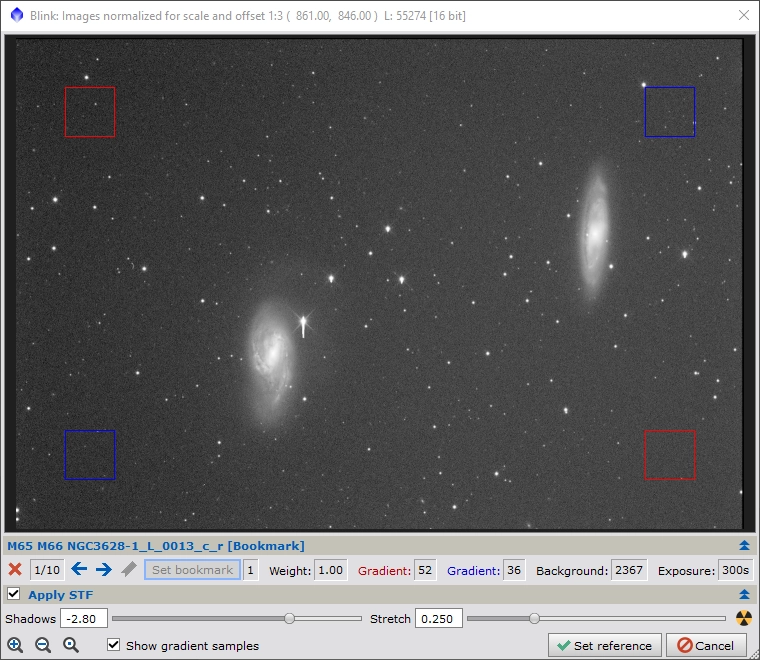
The NSG blink dialog is specialized for finding the best reference image:


NSG Blink

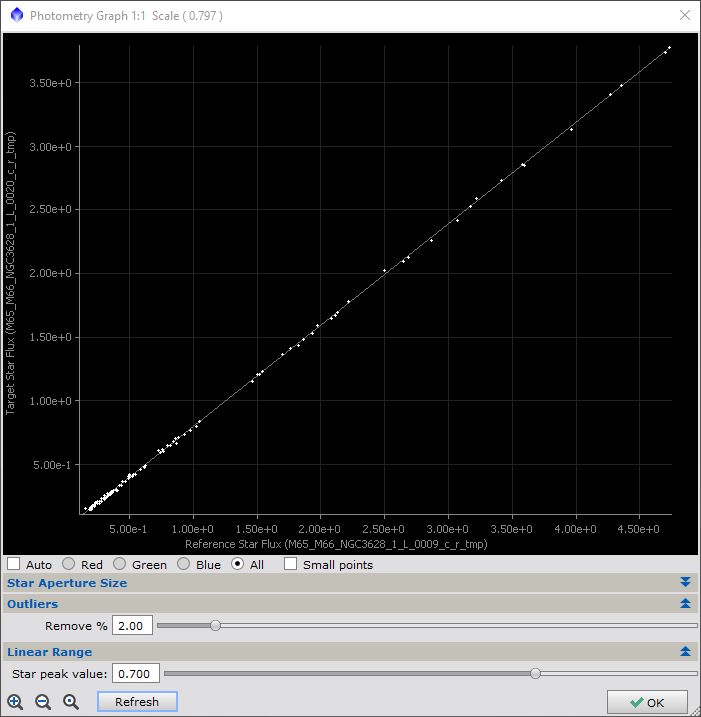
Accurate scale factor

Photometry is used to determine a very accurate (brightness) scale factor. Great care is taken to ensure that exactly the same stars are used in the reference and target images.

Photometry

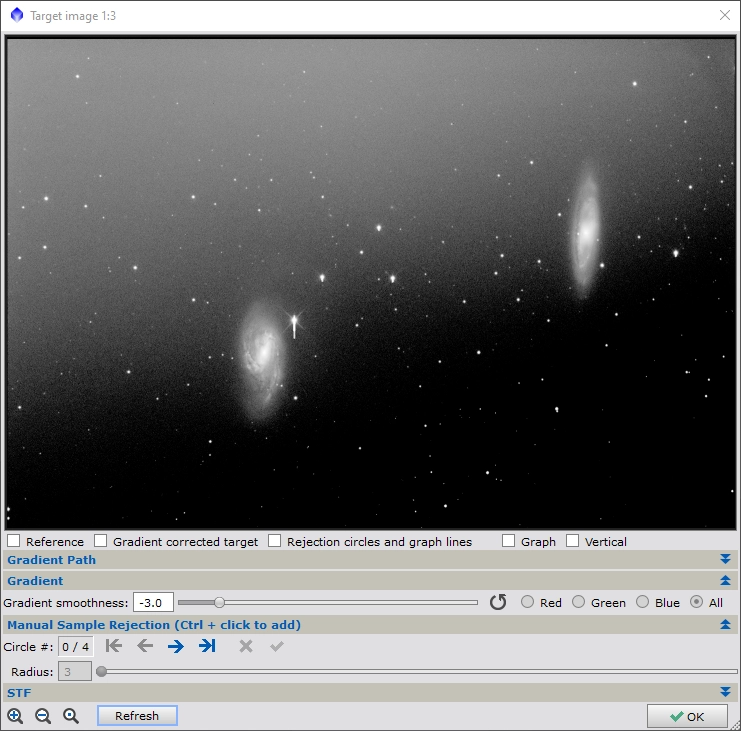
Gradient correction: What you see is what you get.

Mouse over the image to display the gradient correction. This simulates the user toggling the 'Gradient corrected target' checkbox. If the reference checkbox is not selected (as in this example), it blinks between the uncorrected and corrected target image.

If the reference checkbox is selected, it blinks between the reference image and corrected target image. Modify the 'Gradient smoothness' until the correction is excellent. What you see is what you get, making it easy to achieve optimum results.

Uncorrected / corrected image

It is important to understand that NSG is designed to make the target image's gradient match the reference image. Any gradient in the reference image will remain and must be removed after stacking with a process such as DynamicBackgroundExtraction.

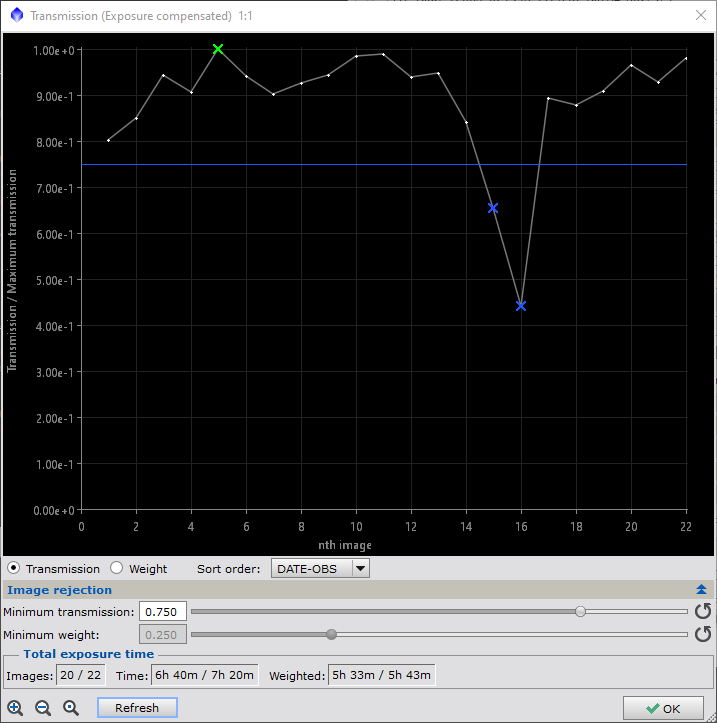
Transmission graph: Detect the clouds!

A sudden dip indicates a reduction in the astronomical signal (this graph ignores variations in light pollution). A sudden dip indicates clouds, or a partially obscured telescope aperture (for example, by the dome).

Clouded images are always worth removing because they can introduce complex gradients that are difficult to remove. We want our image to faithfully represent the astronomical object, and not the local weather conditions!

Transmission graph

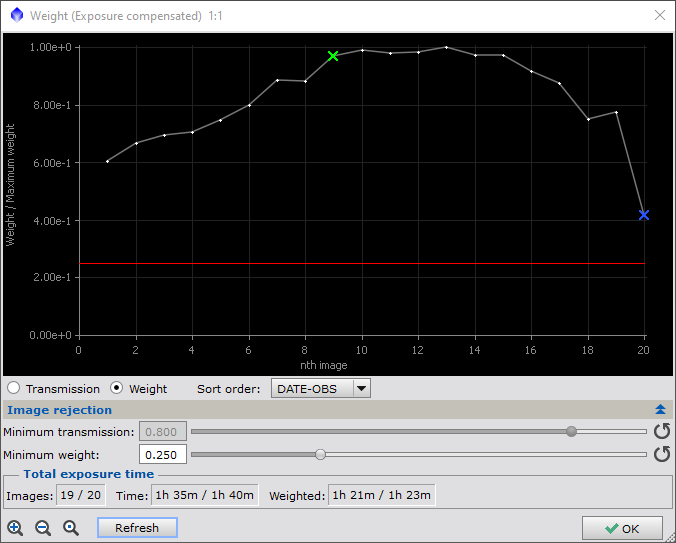
Weight graph: Specify image weight cut off.

The image weight is calculated from the (signal to noise ratio)². This is affected by transmission, light pollution and camera noise.

Weight graph

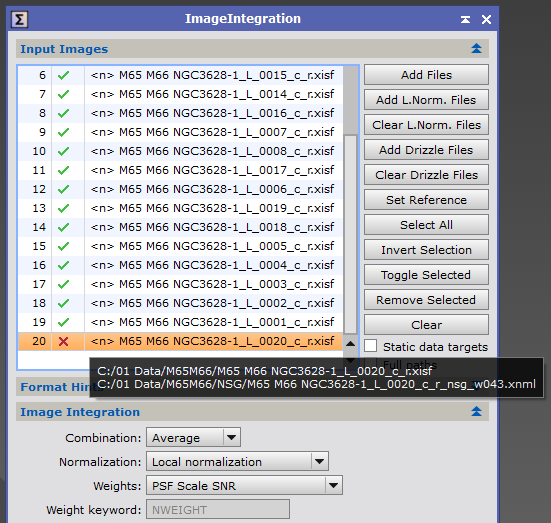
ImageIntegration: Displayed on NSG exit.

On NSG's exit, ImageIntegration is invoked, configured to use NSG's results.

The Normalization is set to 'Local normalization' (In hindsight, I should probably have called NSG 'PhotometricLocalNormalization', but it's probably too late to change its name now). ImageIntegration will use the *.xnml local normalization files that NSG created. These files contain the (brightness) scale factor and gradient correction; ImageIntegration will apply them to the target images.

The 'Weights' is set to 'PSF Scale SNR'. This instructs ImageIntegration to use the weights that NSG calculated and stored within the *.xnml local normalization files.

The target files are added to ImageIntegration in order of decreasing weight. Images that failed either the transmission or weight cutoff criteria are disabled with a 'x'.

ImageIntegration