
The Demon39s Stele The Dog Princess Alpha V2 !!hot!! -
If you want to explore more about the title, community-managed resources like the Anime-Sharing H-Games Wiki provide detailed spreadsheets outlining every specific dialogue trigger and asset unlock code. Share public link
: Players can now adjust colors for clothing and the hero's body tone. New accessories, such as glasses and various sock designs, have also been added.
If you wish to lean into the dark fantasy elements of the Stele, you can fully embrace her animalistic transformation. the demon39s stele the dog princess alpha v2
In the realm of manga and anime, certain titles manage to capture the imagination of fans worldwide, leaving an indelible mark on the industry. One such title that has garnered significant attention in recent years is "The Demon's Stele" or more specifically, its updated version, "The Demon's Stele: The Dog Princess Alpha V2". This article aims to provide an in-depth look into this captivating series, exploring its origins, plot, themes, and the reasons behind its popularity.
: The "Missionary" position now allows players to manually open/close legs to interact with clothing (undies) and includes "asleep" and "deep asleep" states. Ending Variations "Dog Form" ending If you want to explore more about the
The story centers on a cursed “Dog Princess”—an omega werewolf reduced to a beast-like servant. She discovers an ancient stele belonging to a demon lord, which offers power in exchange for a soul bond. The “Alpha V2” subtitle suggests a hierarchical shifter society where she rises from outcast to alpha, possibly through demonic possession or reincarnation.
This article serves as the definitive guide to Alpha V2—its lore, its mechanical upgrades from the previous build, its controversial protagonist (the titular "Dog Princess"), and why the "Demon's Stele" itself is rewriting the rules of cosmic horror romance. If you wish to lean into the dark
The indie simulation scene has seen numerous unique, narrative-driven titles, but few have sparked as much conversation and consistent development interest as HappyLambBarn's . Following the success of previous versions, the developer has continued to expand the game, leading to discussions surrounding an "Alpha v2" phase or significant updates, often referenced in the context of improving upon the foundations of version 1.07. This article dives into the features, evolving narrative, and gameplay mechanics of the ongoing development of this peculiar simulation game. What is The Demon's Stele & The Dog Princess?
In this context, that represented a massive leap in technical polish, customization, and features over the original 2020 release.
"The Demon's Stele: The Dog Princess Alpha V2" matters for several reasons. Firstly, it represents a fusion of traditional Japanese culture with modern storytelling, creating a unique narrative that appeals to a global audience. Secondly, it challenges conventional gender roles and stereotypes, presenting strong female characters in leading roles.
The dog princess’s responses are refined, particularly when falling asleep in certain scenarios, to feel more appropriate to the narrative context. Gameplay Mechanics and Strategy
eFatigue gives you everything you need to perform state-of-the-art fatigue analysis over the web. Click here to learn more about eFatigue.
The Demon39s Stele The Dog Princess Alpha V2 !!hot!! -
Welds may be analyzed with any fatigue method, stress-life, strain-life or crack growth. Use of these methods is difficult because of the inherent uncertainties in a welded joint. For example, what is the local stress concentration factor for a weld where the local weld toe radius is not known? Similarly, what are the material properties of the heat affected zone where the crack will eventually nucleate. One way to overcome these limitations is to test welded joints rather than traditional material specimens and use this information for the safe design of a welded structure.
One of the most comprehensive sources for designing welded structures is the Brittish Standard Fatigue Design and Assessment of Steel Structures BS7608 : 1993. It provides standard SN curves for welds.
Weld Classifications
For purposes of evaluating fatigue, weld joints are divided into several classes. The classification of a weld joint depends on:
- the macroscopic geometry of the pieces welded,
- the direction of the cyclic stresses, and
- the location of the crack that leads to failure.
Two fillet welds are shown below. One is loaded parallel to the weld toe ( Class D ) and the other loaded perpendicular to the weld toe ( Class F2 ).
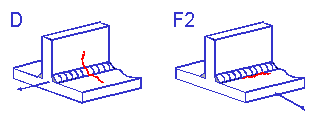
It is then assumed that any complex weld geometry can be described by one of the standard classifications.
Material Properties
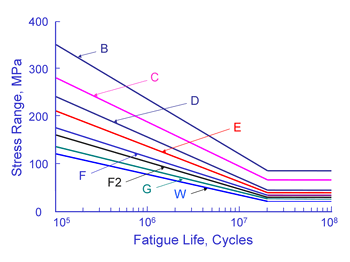
The curves shown above are valid for structural steel welds. Fatigue lives are not dependant on either the material or the applied mean stress. Welds are known to contain small cracks from the welding process. As a result, the majority of the fatigue life is spent in growing these small cracks. Fatigue lives are not dependant on material because all structural steels have about the same crack growth rate. The crack growth rate in aluminum is about ten times faster than steel and aluminum welds have much lower fatigue resistance. Welding produces residual stresses at or near the yield strength of the material. The as welded condition results in the worst possible residual or mean stress and an external mean stress will not increase the weld toe stresses because of plastic deformation. Fatigue lives are computed from a simple power function.

The constant C is the intercept at 1 cycle and is tabulated in the standard. This constant is much larger than the ultimate strength of the material.
The standard is only valid for fatigue lives in excess of 105 cycles and limits the stress to 80% of the yield strength. Experience has shown that the SN curves provide reasonable estimates for higher stress levels and shorter lives. In eFatigue, the maximum stress range permitted is limited by the ultimate strength of the material for all weld classes.
Design Criteria
Test data for welded members has considerable scatter as shown below for butt and fillet welds.
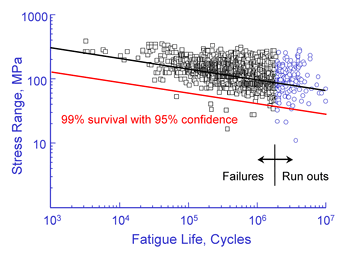
Some of this scatter is reduced with the classification system that accounts for differences between the various joint details. The standard give the standard deviation of the various weld classification SN curves.
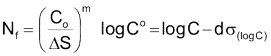
The design criteria d is used to determine the probability of failure and is the number of standard deviations away from the mean. For example d = 2 corresponds to a 2.3% probability of failure and d = 3 corresponds to a probability of failure of 0.14%.
© Ultra Eastern Fjord 2026. All Rights Reserved.